Insights
Sep 14, 2026


Updated July 2026.
Factories may have been around for the best part of two centuries, but those manufacturing startups, rather than physical products, only just entered a fourth decade. Today, we’re covering the startup studio's origin story and how successes, failures, technology, and shifting winds shaped the evolution of its business model.
Startup studios deploy expertise, resources, and infrastructure through a platform approach to generate and validate startup ideas, then build and launch them to market. The studio assigns a leading founder to grow the companies into independent entities with the studio owning the lion’s share of the equity. The expertise and talent pool they provide increases a startup’s odds of survival and success compared to those of regular startups.
Originally, startup studios were fundamentally different from accelerators and incubators, although the line has become increasingly blurred over time. Companies like 757 Collab, Antler, and High Alpha all put a new spin on the model, blending different approaches to yield enormous success.
Now, the beginning.
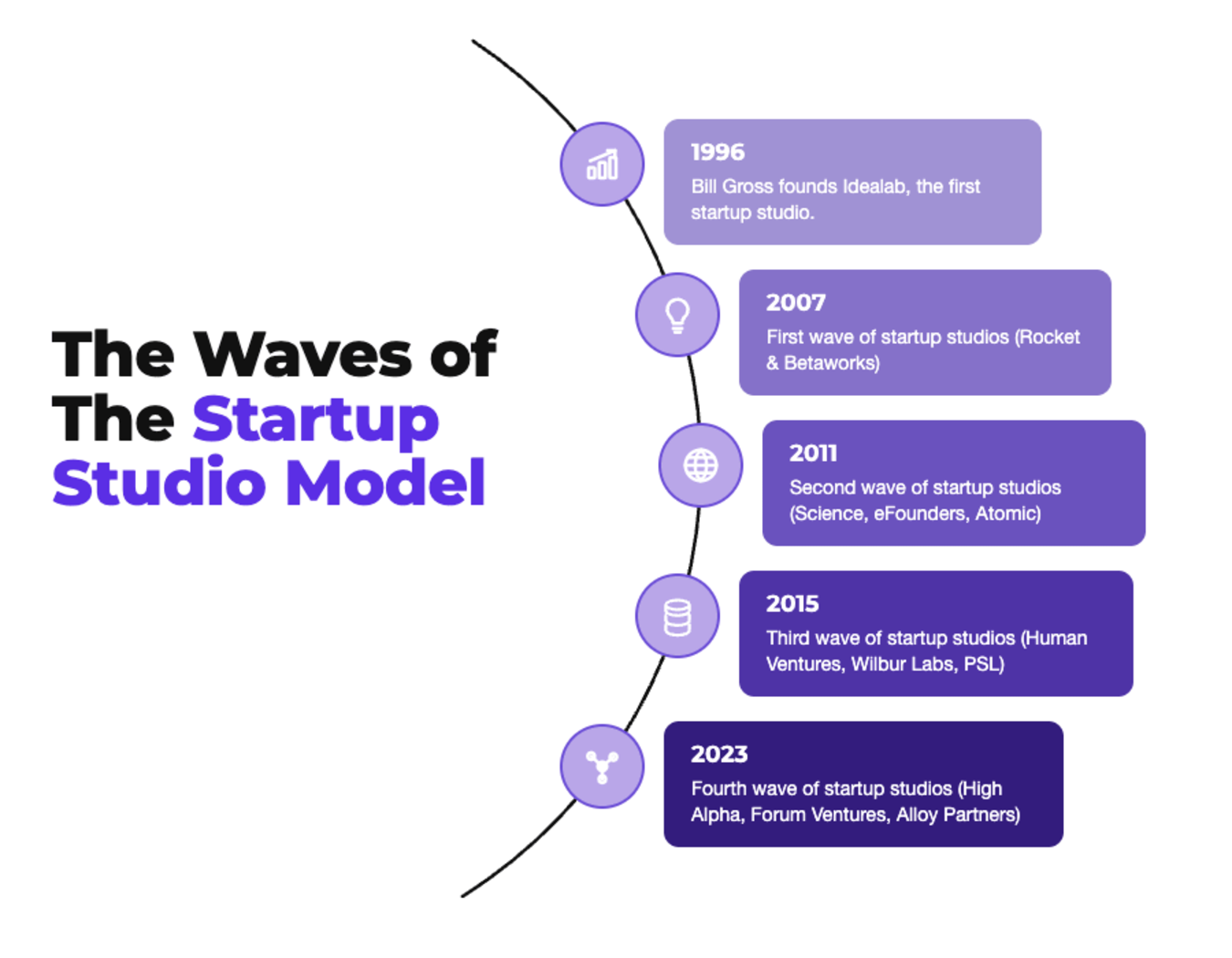
The concept of creating a startup to build other startups, as a well-defined, repeatable process, originated with Bill Gross's founding of Idealab in 1996, originally intended as an incubator.
“Companies that build companies” have existed for years, but Idealab was the first to make it work at scale.

Gross observed that traditional incubators were failing too many great ideas at early stages in the company-building process. Startups rarely had the five key elements needed for success: skilled teams, established processes, industry know-how, fundraising savvy, and investor networks.
Formed in response to the dot-com boom of the late 90s, Idealab spun out company after company, which built the repeatable playbooks it would need to survive the 2000-2001 crash. It was the model’s first major stress test: surviving the bubble it helped inflate.
Today, Idealab has created over 150 companies, with more than 45 IPOs and acquisitions. This list includes notable spinouts like Citysearch, CarsDirect, NetZero, and Tickets.com.
During a TEDx speech, Gross mentioned: “I believe building startups is one of the best ways to make the world a better place. If you bring together a group of people with the same incentive and start a startup with them, you can unleash the potential of these people like never before. You can inspire them to achieve incredible goals.”
Shortly after the creation of Idealab, the first of several waves of startup studios started to appear.
In the late 2000s, the Great Recession created a pool of talented technology and business professionals seeking new opportunities. With many potential business owners struggling financially, entrepreneurs could now turn to a startup studio to reduce overall risk.
The winners followed Idealab’s lead, with top studios such as Rocket and Betaworks at the forefront. Each reacted differently to the 2008 crash, adding their own flavor to the original concept. Rocket mastered the rapid international cloning of proven models, and Betaworks leaned on in-house development.
By now, the startup studio model was hard to ignore. As the model continued to succeed, investors became more willing to back emerging founders, encouraging them to launch venture studios in the industries they knew best.
This 2011 cohort of studios included heavy hitters like eFounders, Science, Wilbur Labs, Human Ventures, and more. Arguably the most successful generation of studios to date, this wave rode the mobile and consumer web boom, bringing today’s vocabulary and investor legitimacy. We covered a few of this era’s biggest success stories earlier this year.
By 2015, startup studios were a well-recognized, fundable category. Venture capital was drawn to cheap infrastructure, whether cloud or open-source, making it affordable to run parallel bets. The focus was now on producing as many ideas as possible and ruthlessly choosing which ones could reach maturity after a short observation period.
Pairing the studio with an affiliated fund was the defining innovation of this era, with companies like PSL managing a $27.5M raise, adding another $80M in 2018. Financing had always been a challenge for the model. This approach solved it.
The studios that thrived championed discipline in how they validated ideas. They could ruthlessly move on from weak ideas early on, before they burned capital.
As the market nears a fourth year of the AI shift, the newest studio models are still emerging rather than proven. Unlike earlier eras, this wave hasn’t been tested by a real downturn yet.
AI’s main impact has been to collapse execution costs, allowing everyone to build and scale quickly. Decisively filtering out winners from losers has never been more important, and studios need to own the execution leverage that a founder can’t replicate on their own. One savvy entrepreneur may be able to complete the work of a dozen, but they likely don’t have the deep industry knowledge, repeatable processes, and diversity of skill sets that a studio team does.
Newer studios like Alloy Partners are running 1,100+ agents, and established partners like High Alpha and Forum Ventures are becoming more AI-native.
The model has thrived amid the boom-and-bust cycles over the following three decades, and each era was characterized by a different set of traits that yielded the most successes:
Across each, the core premise remains the same. Studios originate internally and build rather than fund or advise, a principle that has proven its effectiveness and resilience in countless business environments.
The studio community is stronger than ever. Networking among entrepreneurs, venture capitalists, and digital agencies that follow this approach fosters a vibrant community focused on cooperation rather than competition. After three decades of evolution, we’re looking forward to seeing how the model will change in the next three.
Explore our startup studio directory for a comprehensive list of today’s most cutting-edge studios.